Differential Expression Analysis of the ALL Chiaretti Microarray Dataset with pylimma
This tutorial walks through a pre-normalised microarray workflow. The expression matrix arrives RMA-normalised, so voom is skipped; the analysis goes straight from the matrix to lm_fit.
R-parity validation: the sibling notebook `all_R_vs_Python.ipynb <all_R_vs_Python.ipynb>`__ runs R limma 3.66.0 on the same input and compares the outputs numerically.
Dataset
Chiaretti et al. 2004, Blood 103:2771-2778: Acute Lymphoblastic Leukemia gene-expression profiles from 128 patients on Affymetrix HG-U95Av2 arrays. The shipped matrix is the 12,625-probe RMA-normalised expression set from the BioBase::ALL Bioconductor package.
Biological question: B-cell (B) vs T-cell (T) derived leukemia cases.
Pipeline
Load expression matrix + phenotype targets
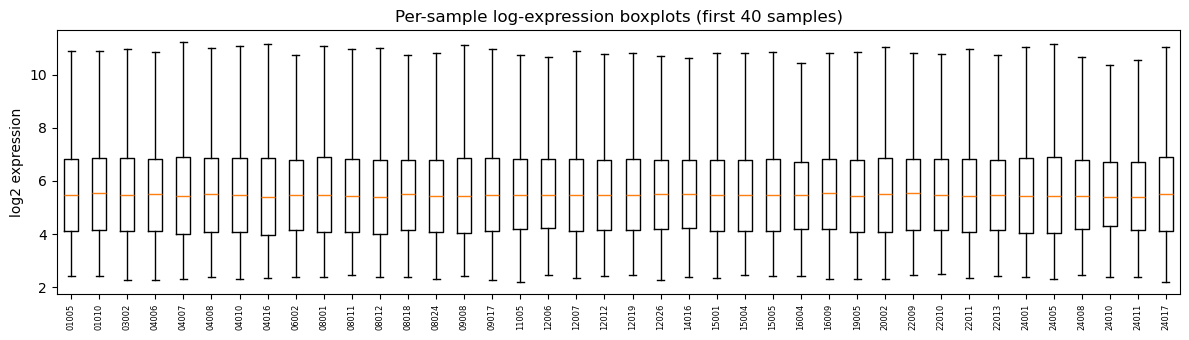
Per-sample distribution QC (boxplot)
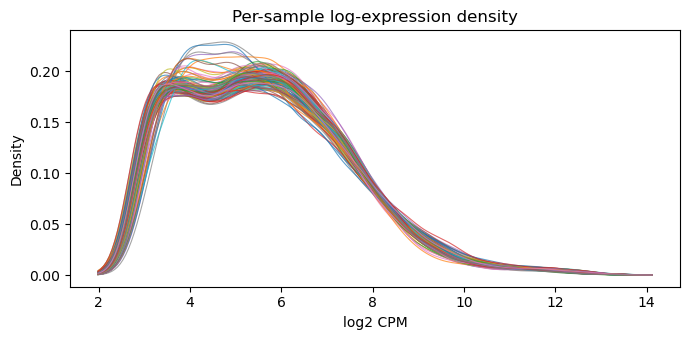
log-expression kernel density (sanity check)
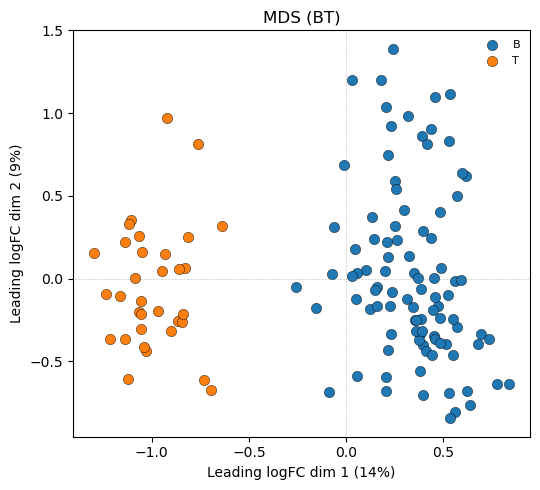
MDS (coloured by BT)
Design matrix
lm_fit+contrasts_fitEmpirical Bayes moderation
Top table and DE calling
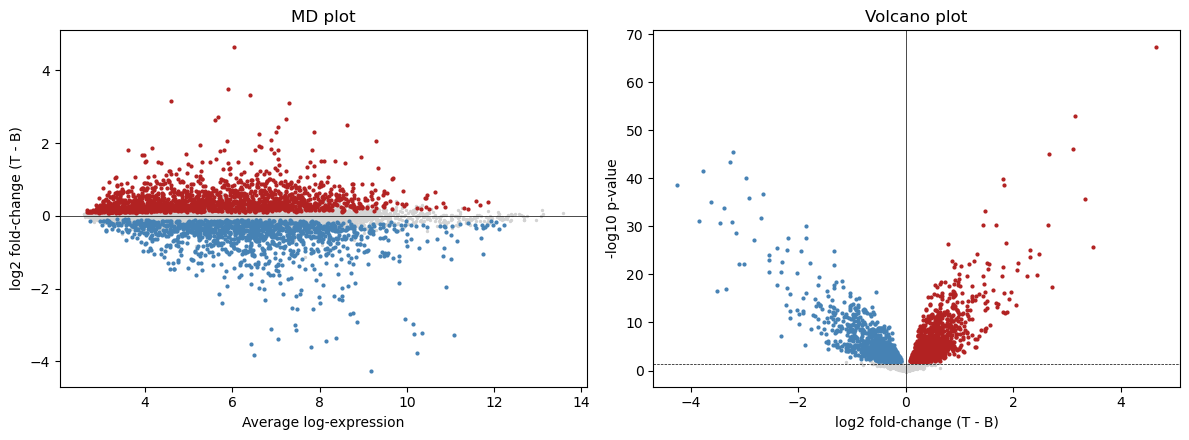
MD + volcano plots
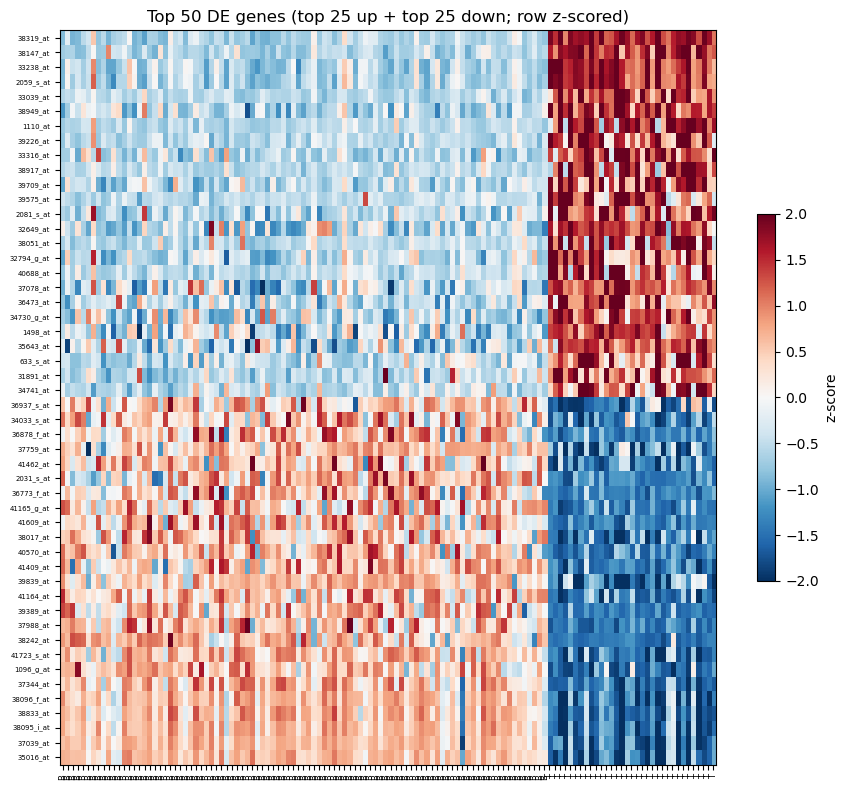
Heatmap of top 50 DE probes (row-ordered by signed t)
Summary
[1]:
import sys
from pathlib import Path

import matplotlib.pyplot as plt
import numpy as np
import pandas as pd

REPO = Path.cwd().resolve().parents[1]
sys.path.insert(0, str(REPO))
sys.path.insert(0, str(REPO / 'data'))

import generate_data as gd

import pylimma

pd.set_option('display.width', 120)
pd.set_option('display.max_columns', 10)

# Shared plotting helpers used by every tutorial.

def _log_cpm(mat, lib_size):
    cpm = mat.div(lib_size, axis=1) * 1e6 if hasattr(mat, 'div') \
          else (mat / lib_size) * 1e6
    return np.log2(cpm + 1e-2)


def plot_log_cpm_density(mat, ax, title=""):
    '''Kernel-smoothed log-CPM density, one line per sample.

    Matches edgeR/limma's standard density plot (limma User's Guide
    Figure 15.1): a Gaussian KDE per sample drawn on a shared grid.
    '''
    from scipy.stats import gaussian_kde
    arr = mat.values if hasattr(mat, 'values') else np.asarray(mat)
    # Shared evaluation grid spanning the combined range.
    lo, hi = np.nanmin(arr), np.nanmax(arr)
    grid = np.linspace(lo, hi, 200)
    for j in range(arr.shape[1]):
        col = arr[:, j]
        col = col[np.isfinite(col)]
        if col.size < 2:
            continue
        kde = gaussian_kde(col)
        ax.plot(grid, kde(grid), linewidth=0.8, alpha=0.7)
    ax.set_xlabel('log2 CPM')
    ax.set_ylabel('Density')
    ax.set_title(title)


def mds_coords(mat, top=500):
    '''Pairwise leading-logFC MDS, matching R limma's plotMDS.default.

    Returns the (n_samples, ndim) coordinate matrix and the percent of
    variance explained per dimension. We reuse pylimma's private
    _mds_coordinates for consistency with plot_mds().
    '''
    from pylimma.plotting import _mds_coordinates
    r = _mds_coordinates(np.asarray(mat, dtype=np.float64), top=top,
                         gene_selection='pairwise', ndim=2)
    lam = np.maximum(r['eigen_values'], 0.0)
    coords = r['eigen_vectors'] * np.sqrt(lam)
    return coords, r['var_explained']


def plot_mds_coloured(mat, groups, ax, top=500, title='MDS'):
    '''MDS scatter plot coloured by sample group.'''
    coords, var_exp = mds_coords(mat, top=top)
    pct = np.round(var_exp * 100).astype(int)
    groups = np.asarray(groups)
    levels = sorted(pd.unique(groups))
    palette = plt.get_cmap('tab10').colors
    for k, level in enumerate(levels):
        m = groups == level
        ax.scatter(coords[m, 0], coords[m, 1],
                   s=55, color=palette[k % len(palette)],
                   label=str(level), edgecolor='k', linewidth=0.3)
    ax.axhline(0, color='grey', linewidth=0.4, linestyle=':')
    ax.axvline(0, color='grey', linewidth=0.4, linestyle=':')
    ax.set_xlabel(f'Leading logFC dim 1 ({pct[0]}%)')
    ax.set_ylabel(f'Leading logFC dim 2 ({pct[1]}%)')
    ax.set_title(title)
    ax.legend(fontsize=8, frameon=False)


def plot_heatmap(E, groups, fit, n_top=50, ax=None):
    '''Heatmap of top-n DE rows showing BOTH directions.

    Picks the top n/2 genes with the most positive t and the top n/2
    with the most negative t (by smallest p within each side), then
    stacks them - up-regulated in the contrast at top, down-regulated
    at bottom. Row z-scored.'''
    t = np.asarray(fit['t']).ravel()
    p = np.asarray(fit['p_value']).ravel()
    half = n_top // 2
    up_pool   = np.where(t > 0)[0]
    down_pool = np.where(t < 0)[0]
    top_up    = up_pool[np.argsort(p[up_pool])[:half]]
    top_down  = down_pool[np.argsort(p[down_pool])[:n_top - half]]
    # Sort each block by signed t descending so most-up is top and
    # most-down is bottom.
    top_up   = top_up[np.argsort(-t[top_up])]
    top_down = top_down[np.argsort(-t[top_down])]
    ordered  = np.concatenate([top_up, top_down])

    mat = E[ordered]
    col_order = np.argsort(groups)
    mat_sorted = mat[:, col_order]
    z = (mat_sorted - mat_sorted.mean(axis=1, keepdims=True)) / \
        (mat_sorted.std(axis=1, keepdims=True) + 1e-8)

    if ax is None:
        fig, ax = plt.subplots(figsize=(9, 8))
    im = ax.imshow(z, aspect='auto', cmap='RdBu_r', vmin=-2, vmax=2)
    ax.set_xticks(range(len(col_order)))
    ax.set_xticklabels(np.asarray(groups)[col_order], rotation=90, fontsize=6)
    ax.set_yticks([])
    ax.set_title(f'Top {n_top} DE genes (top {half} up + top {n_top - half} down; row z-scored)')
    return ax, im, ordered
1. Load the expression matrix + phenotype targets
[2]:
data = gd.load_all()
expr    = data['expr']
targets = data['targets']
print(f"expression matrix: {expr.shape}  (probes x samples)")
group = targets["BT"].astype(str).str[0]
print("\nBT breakdown:")
print(group.value_counts())
targets[['BT', 'mol.biol', 'sex', 'age']].head()
expression matrix: (12625, 128)  (probes x samples)

BT breakdown:
BT
B    95
T    33
Name: count, dtype: int64
[2]:
| BT | mol.biol | sex | age | |
|---|---|---|---|---|
| 01005 | B2 | BCR/ABL | M | 53.0 |
| 01010 | B2 | NEG | M | 19.0 |
| 03002 | B4 | BCR/ABL | F | 52.0 |
| 04006 | B1 | ALL1/AF4 | M | 38.0 |
| 04007 | B2 | NEG | M | 57.0 |
2. Per-sample distribution QC
[3]:
fig, ax = plt.subplots(figsize=(12, 3.5))
ax.boxplot(expr.iloc[:, :40].values, labels=expr.columns[:40],
           showfliers=False)
ax.set_xticklabels(expr.columns[:40], rotation=90, fontsize=6)
ax.set_ylabel('log2 expression')
ax.set_title('Per-sample log-expression boxplots (first 40 samples)')
fig.tight_layout()
plt.show()
/var/folders/0x/4309q_jn5xbf3zzq_4hcp2100000gn/T/ipykernel_9229/2015273228.py:2: MatplotlibDeprecationWarning: The 'labels' parameter of boxplot() has been renamed 'tick_labels' since Matplotlib 3.9; support for the old name will be dropped in 3.11.
  ax.boxplot(expr.iloc[:, :40].values, labels=expr.columns[:40],
3. log-expression density (KDE)
Kernel density per sample. After RMA all samples should be nearly super-imposed - a visible outlier would warrant follow-up before differential analysis.
[4]:
fig, ax = plt.subplots(figsize=(7, 3.5))
plot_log_cpm_density(expr, ax, 'Per-sample log-expression density')
fig.tight_layout()
plt.show()
4. MDS (coloured by BT)
[5]:
fig, ax = plt.subplots(figsize=(5.5, 5))
plot_mds_coloured(expr.values, group.values, ax,
                  top=500, title='MDS (BT)')
fig.tight_layout()
plt.show()
5. Design matrix
[6]:
design, C = gd.build_two_group_design(group)
design_df = pd.DataFrame(design, index=expr.columns,
                         columns=sorted(group.unique()))
print(f"Design: {design_df.shape}, contrast = T - B")
design_df.head(8)
Design: (128, 2), contrast = T - B
[6]:
| B | T | |
|---|---|---|
| 01005 | 1.0 | 0.0 |
| 01010 | 1.0 | 0.0 |
| 03002 | 1.0 | 0.0 |
| 04006 | 1.0 | 0.0 |
| 04007 | 1.0 | 0.0 |
| 04008 | 1.0 | 0.0 |
| 04010 | 1.0 | 0.0 |
| 04016 | 1.0 | 0.0 |
6. Fit linear models and contrasts (no voom)
[7]:
fit = pylimma.lm_fit(expr.values, design)
fit = pylimma.contrasts_fit(fit, contrasts=C)
print(f"coefficients shape: {fit['coefficients'].shape}")
coefficients shape: (12625, 1)
7. Empirical Bayes moderation
[8]:
fit = pylimma.e_bayes(fit)
print(f"s2_prior: {fit['s2_prior']:.4f}")
print(f"df_prior: {fit['df_prior']:.2f}")
s2_prior: 0.0842
df_prior: 3.03
8. Top table
[9]:
tt = pylimma.top_table(fit, coef=0, number=np.inf, sort_by='p')
tt.index = expr.index[np.argsort(np.asarray(fit['p_value']).ravel())]
print(f"DE calls at adj_p_value < 0.05: {(tt['adj_p_value'] < 0.05).sum():,} probes")
tt.head(10)
DE calls at adj_p_value < 0.05: 3,024 probes
[9]:
| log_fc | ave_expr | t | p_value | adj_p_value | b | |
|---|---|---|---|---|---|---|
| 38319_at | 4.655042 | 6.041217 | 35.302014 | 3.665982e-68 | 4.628303e-64 | 142.887385 |
| 38147_at | 3.154743 | 4.582970 | 26.368452 | 8.329164e-54 | 5.257785e-50 | 111.276776 |
| 33238_at | 3.102294 | 7.292159 | 22.711375 | 6.493588e-47 | 2.732718e-43 | 95.863304 |
| 35016_at | -3.214222 | 10.337892 | -22.347402 | 3.433264e-46 | 1.083624e-42 | 94.239065 |
| 2059_s_at | 2.668482 | 7.232735 | 22.156246 | 8.286073e-46 | 2.092233e-42 | 93.379248 |
| 37039_at | -3.265990 | 11.072596 | -21.343275 | 3.694071e-44 | 7.772940e-41 | 89.669946 |
| 38095_i_at | -3.762299 | 10.228156 | -20.426219 | 2.955978e-42 | 5.331317e-39 | 85.382469 |
| 38833_at | -2.966787 | 10.144085 | -19.764032 | 7.473721e-41 | 1.179447e-37 | 82.217871 |
| 33039_at | 1.812889 | 3.619621 | 19.685785 | 1.098739e-40 | 1.541287e-37 | 81.840104 |
| 38096_f_at | -4.248782 | 9.169628 | -19.055233 | 2.522408e-39 | 3.184540e-36 | 78.766423 |
9. MD + volcano plots
[10]:
logFC = fit['coefficients'][:, 0]
AveExpr = fit.get('Amean') if fit.get('Amean') is not None \
          else expr.mean(axis=1).values
adj_sig = pylimma.decide_tests(fit, p_value=0.05).ravel() != 0

fig, (axMD, axV) = plt.subplots(1, 2, figsize=(12, 4.5))
# MD
axMD.scatter(AveExpr[~adj_sig], logFC[~adj_sig], s=2, c='lightgrey')
axMD.scatter(AveExpr[adj_sig & (logFC > 0)],
             logFC[adj_sig & (logFC > 0)], s=4, c='firebrick')
axMD.scatter(AveExpr[adj_sig & (logFC < 0)],
             logFC[adj_sig & (logFC < 0)], s=4, c='steelblue')
axMD.axhline(0, color='k', linewidth=0.5)
axMD.set_xlabel('Average log-expression')
axMD.set_ylabel('log2 fold-change (T - B)')
axMD.set_title('MD plot')

# Volcano
p = np.asarray(fit['p_value']).ravel()
neglogp = -np.log10(np.maximum(p, 1e-300))
axV.scatter(logFC[~adj_sig], neglogp[~adj_sig], s=2, c='lightgrey')
axV.scatter(logFC[adj_sig & (logFC > 0)],
            neglogp[adj_sig & (logFC > 0)], s=4, c='firebrick')
axV.scatter(logFC[adj_sig & (logFC < 0)],
            neglogp[adj_sig & (logFC < 0)], s=4, c='steelblue')
axV.axhline(-np.log10(0.05), color='k', linewidth=0.5, linestyle='--')
axV.axvline(0, color='k', linewidth=0.5)
axV.set_xlabel('log2 fold-change (T - B)')
axV.set_ylabel('-log10 p-value')
axV.set_title('Volcano plot')
fig.tight_layout()
plt.show()
10. Heatmap of top 50 DE probes
Rows ordered by signed t-statistic (up-regulated at top, down-regulated at bottom). Columns grouped by BT.
[11]:
fig, ax = plt.subplots(figsize=(9, 8))
ax, im, ordered = plot_heatmap(expr.values, group.values, fit,
                                n_top=50, ax=ax)
ax.set_yticks(range(len(ordered)))
ax.set_yticklabels(expr.index[ordered], fontsize=5)
fig.colorbar(im, ax=ax, shrink=0.5, label='z-score')
fig.tight_layout()
plt.show()